
Media Release August 22nd
Where does the future value of a vineyard sit?
Pause, Preserve or Remove? Vineyard Management in Transition
For more than 90 growers, viticulturists and wine producers from across Western Australia, the question on 13 August wasn’t simply whether to keep or remove a vineyard; It was a more difficult question: where is the future value in the vineyard, and what needs to happen to protect it?
That was the conversation at Pause, Preserve or Remove? Vineyard Management in Transition, a half-day workshop held in Margaret River and streamed live to attendees across the state.
With rising costs, changing market conditions and increasing pressure on vineyard profitability, growers are being asked to make decisions that can have consequences for years to come. The workshop brought together practical expertise, commercial thinking and grower experience to help make those decisions more deliberate and less about instinct, habit or simply putting off the hard call.
Wines of WA Sustainability and Industry Development Program Manager Eloise Jarvis reflects:
“The decision to pause, preserve or remove a vineyard is complex, and for many, emotional. Being a responsible neighbour is central to it – biosecurity, fire risk and pest and disease load all factor in, not just the numbers.
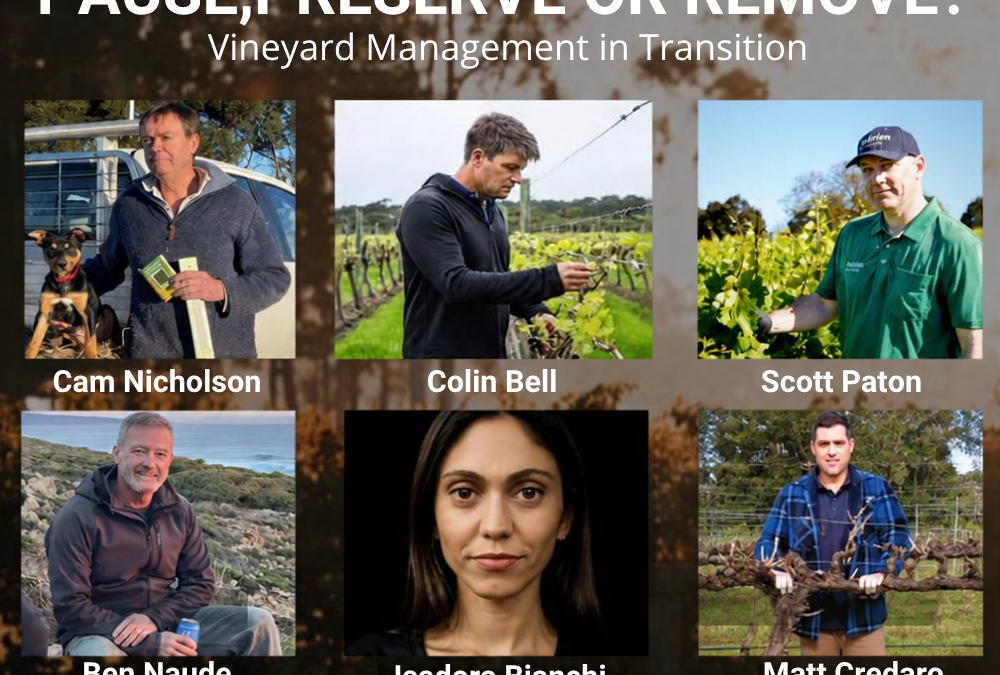
What stood out most was the generosity of our wine community: Cam Nicholson’s decision-making framework set the foundation, but it was Colin Bell, Scott Paton, Ben Naude and Matt Credaro’s candid breakdown of their own process that added the real value. The key message was clear – knowing your vineyard’s average isn’t enough. For long-term resilience, you need to know it block by block, which is exactly what Wines of WA’s Wine Forward pilot offers. I hope everyone who attended found the day helpful and meaningful.”
One of the strongest themes to emerge was that the vineyard shouldn’t necessarily be the unit of decision-making, the block should be.
As Colin Bell of AHA Viticulture put it, “a vineyard can be a collection of very different businesses sitting alongside one another. One block may be earning its keep while another is quietly losing value. Looking at the vineyard as an average can hide both.”
That idea shifted the conversation from “What should I do with my vineyard?” to much more useful questions: Who wants the fruit? Can the block deliver consistently? What does it take to operate? What does it really cost? And is it worth continuing to invest there?
Cam Nicholson of Nicon Rural Services provided a framework for working through those questions, highlighting the importance of identifying the critical factors, understanding where the tipping points sit and making a considered decision with the best information available, rather than waiting for hindsight to tell you whether it was the right one.
The practical realities were equally important. Discussions led by Colin Bell, Scott Paton of Nutrien Ag and Ben Naude of Teams Work explored what different pathways actually mean on the ground, from reduced management and maintaining a block through to vine removal, site remediation, labour, machinery and cost.
One important distinction was that pausing isn’t the same as walking away. A block placed into care and maintenance still needs a deliberate management program if it is to remain healthy, compliant and potentially recoverable.
Matt Credaro then brought the discussion back to the reality of running a wine business, sharing how Credaro Family Estate assesses vineyard feasibility on a site-by-site basis. His case study demonstrated that two blocks within the same business can arrive at very different conclusions, reinforcing the value of looking beyond averages and understanding the individual role and future potential of each site.
The final piece of the conversation looked further ahead.
Through Wine Forward, Isidora Bianchi of ClimAdapt explored how climate, soils and terrain can add another layer of information to block-level decisions, helping growers consider not just whether a block works today, but whether its location and characteristics will continue to support its intended variety and business role into the future.
Perhaps the most useful takeaway from the morning was that there is no single answer to the question of pause, preserve or remove. The answer depends on the block, the business, the market, the resources available and what the vineyard needs to deliver in the years ahead.
And sometimes, the best decision isn’t about saving every hectare. It’s about knowing where the future value sits and having the confidence to act on it.
The conversation also reinforced that these decisions extend beyond individual businesses. Neglected or poorly managed vineyards can create biosecurity risks for neighbouring properties and the broader industry, making responsible vineyard management an important part of being a good industry neighbour.
With 91 attendees across the in-person and online formats, the strong response demonstrated that vineyard transition is a conversation the WA wine industry is ready to have. These conversations matter because no one should have to make these calls alone. Staying connected to your neighbours, your region and your industry isn’t separate from good vineyard management – it’s part of it.
Pause, Preserve or Remove? was coordinated and funded by Wines of Western Australia through the Western Australian Wine Industry Partnership, an industry-led initiative supported by the Western Australian Government, with support from the Margaret River Wine Association.
ENDS
For media enquiries please contact Eloise Jarvis at [email protected]
Phone: 0447 587 151
Recent Comments